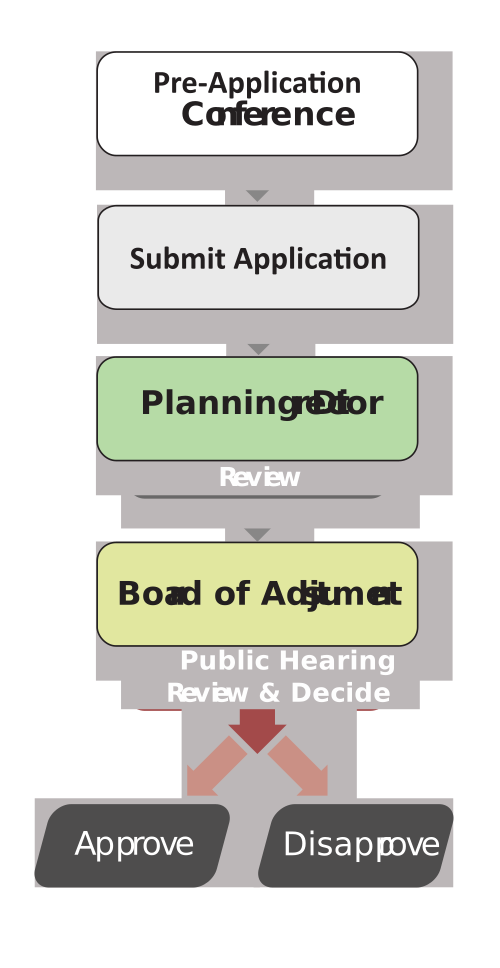
Applicability The Board of Adjustment has the authority to authorize variances from the provisions of this UDO, subject to the requirements of this section. Provided, however, no variance shall be allowed to any provision of this UDO, which would result in an amendment to the 2030 Comprehensive Plan, the Street Plan, or any other adopted City plan. Any change or amendment to such plans or maps must be done in accordance with the process set forth in Sec. 10.2.2. for 2030 Comprehensive Plan amendments.
Pre-Application Conference Before submitting an application for a variance, an applicant shall schedule a pre-application conference with the Planning Director to discuss the procedures, standards and regulations required for approval. This requirement may be waived at the discretion of the Planning Director.
Application Requirements
An application for a variance shall be submitted in accordance with Sec. 10.2.1.B.
A Variance Application must be signed and notarized by the property owner in order to initiate a request for variance.
Approval Process
Planning Director Action City Planning shall review the application for a variance in light of the showings of Sec. 10.2.10.D.3. below and advise the applicant.
Board of Adjustment Action Following notice as required in Sec. 10.1.8. and Sec. 10.2.1.C., the Board of Adjustment shall hold a quasi-judicial public hearing as set forth in Sec. 10.2.1.D.1..
Showings Before a variance request is granted, the Board of Adjustment shall show all of the following:
Unnecessary hardship would result from the strict application of the ordinance. It shall not be necessary to demonstrate that, in the absence of the variance, no reasonable use can be made of the property.
The hardship results from conditions that are peculiar to the property, such as location, size or topography. Hardships resulting from personal circumstances, as well as hardships resulting from conditions that are common to the neighborhood or the general public, may not be the basis for granting a variance. A variance may be granted when necessary and appropriate to make a reasonable accommodation under the Federal Fair Housing Act for a person with a disability.
The hardship did not result from actions taken by the applicant or the property owner. The act of purchasing property with knowledge that circumstances exist that may justify the granting of a variance is not a self-created hardship.
The requested variance is consistent with the spirit, purpose and intent of the ordinance, such that public safety is secured and substantial justice is achieved.
Approval Limitations and Conditions
Absent specific authority from this UDO, the Board of Adjustment may not grant a variance which would modify, alter, change or suspend any requirement of a use standard as set forth in Chapter 6. Use Regulations.
In granting a variance, the Board of Adjustment is authorized to attach safeguards and conditions to the approved variance as is necessary and appropriate and reasonably related to the circumstances that gave rise for the need of the variance.
Expiration of Variance A variance shall expire after 24 months from the date of approval of the written decision by the Board of Adjustment unless: (i) work authorized by the variance has substantially commenced; or (ii) the use/or and structure to which the variance applies were previously in existence prior to the requested variance. For uncompleted projects which were timely commenced pursuant to this Section, a variance expires if the development work is thereafter intentionally and voluntarily discontinued for a period of not less than 24 consecutive months. This 24-month discontinuance period may be automatically tolled in the event of litigation, in accordance with 160D-108(d).