
Home
Raleigh UDO

Main navigation

  • Table of Contents
  • Recent Updates
  • History Table

Breadcrumb

  1. Home
  2. CHAPTER 10. ADMINISTRATION
  3. Article 10.2. Review Procedures

Sec. 10.2.15. Certificate of Appropriateness

  1. Jurisdiction
    1. The Certificate of Appropriateness Committee (hereinafter “COA Committee”) has jurisdiction for certificates of appropriateness for the exterior of all properties within the -HOD-G and -HOD-S.
    2. The COA Committee has jurisdiction for certificates of appropriateness for the exterior of Historic Landmarks within Raleigh’s zoning jurisdiction.
    3. The COA Committee has jurisdiction for certificates of appropriateness for all designated interior spaces of Historic Landmarks within Raleigh’s zoning jurisdiction.
    4. Per North Carolina Session Law 1993-168, the Historic Development Commission has delegated to the Certificate of Appropriateness Committee its jurisdiction to issue certificates of appropriateness for all matters listed in 10.2.15(A)(1)–(3) above.
  2. Expiration of Certificate of Appropriateness
    1. A certificate of appropriateness shall expire 12 months after decision is filed with the Clerk to the COA Committee or approved administratively by staff unless the work authorized by the certificate has substantially commenced.
    2. If after commencement the work is discontinued for a period of 12 months, the permit shall immediately expire.
    3. A certificate of appropriateness authorizing demolition shall expire if the work has not been commenced within 12 months after the effective date set by the Commission. If after commencement the demolition work is discontinued for a period of 12 months, the approval shall immediately expire.
    4. No work authorized by any certificate that has expired shall thereafter be performed until a new certificate has been secured.
  3. Application
    1. An application for a Certificate of Appropriateness shall be submitted in accordance with the general application requirements of Sec. 10.2.1.B. The application must be accompanied by sketches, drawings, photographs, specifications, descriptions and other information of sufficient detail as described on the form to clearly show the proposed exterior alternations, additions, changes, new construction, or alternations to designated interior features of Historic Landmarks. Multiple copies of the application shall be provided when so required by the instructions on the form provided by the City. Applications that are deemed incomplete by staff are not considered filed and will be held until required materials are provided.
    2. Staff may advise the applicant and make recommendations with regard to appropriateness based upon the adopted historic development standards.
    3. The applicant must be either the property owner of the subject property or one of the following individuals authorized by the property owner to make the application:
      1. a person holding a valid option to purchase the property;
      2. a person holding a valid lease for the property; or
      3. a person holding a valid contract to purchase the property.
  4. Approval Process
    1. Deadline
      Applications for certificates of appropriateness shall be reviewed and acted upon within 180 days from the date the application for a certificate of appropriateness is filed, as defined by this regulation. The COA Committee may take the matter under advisement to receive additional evidence or memoranda of authority requested by the Commission for its consideration. Nothing in this paragraph shall prohibit an extension of time where mutual consent is given.
    2. Minor Works
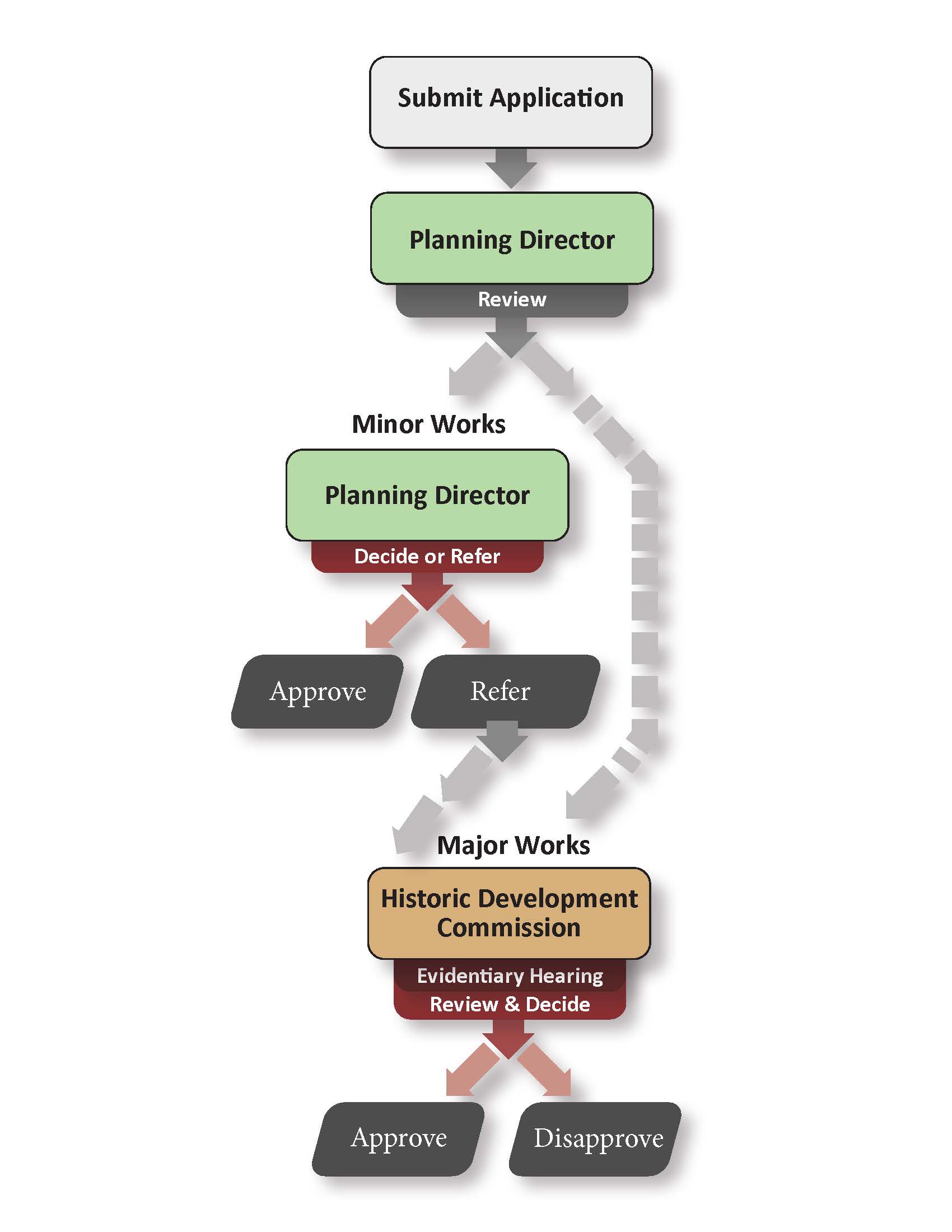
      Upon receipt of a completed application, the Planning Director may issue a certificate of appropriateness for minor works.
      1. Defined
        Minor works are defined as those changes that do not involve substantial alterations, additions or removals that could impair the integrity of the Landmark property or the Historic Overlay District as a whole. Minor works are limited to those listed in the table below. 

        Minor Works List
        Accessory structures (non-character-defining only): Removal of
        Accessory structures under 12 feet in all directions (length, width, or height): Construction/Installation of
        Accessory structures with no expansion of building footprint: Alteration of
        Additions to accessory structures, where the total remains under 12 feet in all directions (height, width, length): Construction of
        Additions to a primary structure 50 sq. ft. or less (rear only): Construction/installation of
        Appurtenant features and accessory site features such as arbor, water feature, pergola, trellis, detached fireplace (non-character-defining only): Alteration/Construction/Installation/Removal of
        Architectural details (non-character-defining only): Alteration/Construction/Installation/Removal of
        Awnings/canopies: Alteration/Construction/Installation/Removal of
        Carports/porte cocheres (non-character-defining only): Alteration/removal of
        Chimneys (non-character-defining only): Alteration/Construction/Installation/Removal of
        Decks that align with the main floor: Alteration/Construction/Installation/Removal of
        Doors/door openings/trim (non-character-defining only): Alteration/removal of
        Doors/door openings/trim on non-character-defining facades: Alteration/Construction/Installation/Removal of
        Driveways: Alteration/Construction/Installation/Removal of
        Exterior surfaces (non-character-defining only): Alteration/Construction/Installation/Removal of
        Fences/walls 6’ in height or less: Alteration/Construction/Installation/Removal of
        Foundations: Alteration of
        Gutters and downspouts: Alteration/Construction/Installation/Removal of
        Hedges or other screen plantings: Alteration/Construction/Installation/Removal of
        Lighting fixtures: Alteration/Construction/Installation/Removal of
        Mailboxes: Alteration/Construction/Installation/Removal of
        Parking lots: Alteration/removal of
        Part of a structure (non-character-defining): Removal of
        Patios: Alteration/Construction/Installation/Removal of
        Porches: Alteration of
        Porches (non-character-defining only): Removal of
        Railings, front step: Alteration/Construction/Installation/Removal of
        Ramps/lifts: Alteration/Construction/Installation/Removal of
        Roof coverings: Alteration of
        Shutters: Alteration/Construction/Installation/Removal of
        Signs: Alteration/Construction/Installation/Removal of
        Skylights: Alteration/Construction/Installation/Removal of
        Solar collectors: Alteration/Removal of
        Solar collectors (on non-front-sloping roofs and not over historic roofing material): Construction/Installation of
        Stairs and steps: Alteration/Construction/Installation/Removal of
        Storefronts or features (non-character-defining only): Alteration/Construction/Installation/Removal of
        Storm doors and storm windows: Alteration/Construction/Installation/Removal of
        Swimming pools: Alteration/Construction/Installation/Removal of
        Trees with a combined stem girth of 10 inches and greater in diameter, measured 4-1/2 feet above ground level when a replacement tree of similar species, mature height, and canopy coverage is proposed: Removal of
        Utility equipment, such as mechanical units, electric vehicle charging units, and meters, satellite dishes and/or antennas: Alteration/Construction/Installation/Removal of
        Vents (non-character-defining only): Alteration/Construction/Installation/Removal of
        Walks: Alteration/Construction/Installation/Removal of
        Windows/window openings/sash/trim (non-character-defining only): Alteration/removal of
        Windows/window openings/sash/trim on non-character-defining facades: Alteration/Construction/Installation/Removal of
        Changes to Certificates of Appropriateness that if, standing alone, would qualify as a Minor Work.
        Renewal of expired Certificates of Appropriateness, except those issued with a demolition delay.
        Work Items not listed here for which a clear citation can be made for congruity with the historic district or landmark using the associated historic development standards.
      2. Procedure
        1. Applications for minor works shall be reviewed by the Planning Director according to the applicable historic development standards.
        2. Staff will refer Minor Work projects to the COA Committee for review if in staff’s judgment the change involves alterations, additions, or removals that are substantial, do not meet the design standards, or are of a precedent-setting nature.
        3. A report of the approved certificates of appropriateness for minor works shall be forwarded to the COA Committee, for its information, at its next regularly scheduled meeting.
        4. Failure to approve the requested minor work by the Planning Director shall in no way interfere with the applicant’s right to be heard by the COA Committee—no application for a certificate of appropriateness may be denied without formal action by the COA Committee.
        5. Appeals of administrative decisions to approve a Minor Work are heard by the COA Committee. Notice of appeal shall be filed with the Department of City Planning and Development within 30 days after the date the application for Minor Works was affirmatively decided.
    3. Major Works
      1. The Planning Director shall prepare a report and transmit the application for a certificate of appropriateness, together with the supporting material, to the review body for its consideration.
      2. Following notice as required in Sec. 10.1.8 and Sec. 10.2.1.C, the COA Committee shall hold a quasi-judicial public hearing as set forth in Sec. 10.2.1.D.1.
      3. Interior arrangement shall not be considered by the COA Committee and no certificate of appropriateness is required for interior repairs or renovations, except for designated interior features of Historic Landmarks as allowed in Sec. 10.2.16.D.2.
      4. The COA Committee shall not refuse to issue a certificate of appropriateness except for the purpose of preventing the changes outlined in 5.4.1.C.2 in the –HOD-G, -HOD-S or for Historic Landmarks, which would be incongruous with the special character of the district or Landmark.
      5. The COA Committee shall render its decision in written form, including its reasons for issuing or denying the certificate and a summary of any citation to the evidence, testimony, studies or other authority upon which it based its decision.
      6. In all proceedings before the COA Committee with regard to an application for a certificate of appropriateness, the burden of producing substantial, competent and material evidence or testimony is upon the applicant and if the applicant fails to do so, the COA Committee shall deny the certificate.
      7. Notwithstanding any other provisions of this UDO, the COA Committee may require additional evidence or memoranda of authority to be submitted and may take the matter under advisement until such evidence or memoranda have been submitted and considered up to the 180-day limit established above.
      8. As part of its deliberation, the COA Committee may view the premises and seek the advice of the North Carolina Division of Archives and History or such other expert advice as it may deem necessary under the circumstances.
      9. The COA Committee's action on the application shall be approval, approval with conditions, deferral or denial.
      10. Notice of decision shall be provided as required in Sec. 10.2.1.C.6.
  5. Demolition of Buildings, Structures and Sites
    1. General
      An application for a certificate of appropriateness authorizing the demolition or destruction of a building, structure or site within any Historic Overlay District or Historic Landmark may not be denied except as provided below for Statewide Significance. However, the effective date of such a certificate may be delayed for a period of up to 365 days from the date of approval. The maximum period of delay authorized by this section shall be reduced by the COA Committee where it finds that the owner would suffer extreme hardship or be permanently deprived of all beneficial use of or return from such property by virtue of the delay. During such period of delay the COA Committee shall negotiate with the owner and with any other parties in an effort to find a means of preserving the building, structure or site. If the COA Committee finds that the building, structure or site has no special significance or value toward maintaining the character of the Historic Overlay District or Historic Landmark, it shall waive all or part of such period and authorize earlier demolition or removal.
    2. Pending Historic Landmark and within a Pending -HOD-G or -HOD-S
      1. Where the Historic Development Commission has voted to recommend designation of a property as a Historic Landmark or an area as a -HOD-G or -HOD-S and final designation has not been made by the City Council, the demolition or destruction of any building, site or structure proposed as a Landmark or located in the proposed district may be delayed by the Commission for a period of up to 180 days through the COA process or until the City Council takes final action on the designation, whichever occurs first.
    3. Statewide Significance
      An application for a certificate of appropriateness authorizing the demolition or destruction of a building, structure or site determined by the State Historic Preservation Officer as having statewide significance as defined in the criteria of the National Register of Historic Places may be denied except where the COA Committee finds that the owner would suffer extreme hardship or be permanently deprived of all beneficial use or return by virtue of the denial.
    4. Compliance with Other Law
      Issuance of a certificate of appropriateness shall not relieve the applicant, contractor, tenant or property owner from obtaining any other permit required by this UDO or any law.
  6. Appeals
    1. Appeals from the Historic Development Commission are to Wake County Superior Court pursuant to N.C. Gen. Stat. §160D-1402
    2. The State of North Carolina shall have a right of appeal to the North Carolina Historical Commission or any successor agency. Notice to the Historic Development Commission shall be served on the same day and in the same manner as for the North Carolina Historical Commission unless oral notice of appeal is given to the Historic Development Commission during the meeting at which the decision is rendered. The decision of the North Carolina Historical Commission shall be final and binding upon both the state and the Historic Development Commission.
  7. Effect of Conflict with Other Ordinances
    Whenever any ordinance adopted pursuant to N.C. Gen. Stat. Part 4, Article 9, Chapter 160D requires a longer waiting period or imposes other higher standards with respect to a designated historic landmark or designated –HOD-G or –HOD-S than are established under any other statute, charter provision or regulation, Part 4 shall govern. Whenever the provisions of any other statute, charter provision, ordinance or regulation require a longer waiting period or impose other higher standards than are established under general statute such other statute, charter provision, ordinance or regulation shall govern.

Book traversal links for Sec. 10.2.15. Certificate of Appropriateness

  • Sec. 10.2.14. Written Interpretation
  • Sec. 10.2.16. Historic Landmark Designation
TC Number
TC-3-24
Ordinance Number
828 TC 494
  • Printer-friendly version

UDO Chapters

  • CHAPTER 1. INTRODUCTORY PROVISIONS
  • CHAPTER 2. RESIDENTIAL DISTRICTS
  • CHAPTER 3. MIXED USE DISTRICTS
  • CHAPTER 4. SPECIAL DISTRICTS
  • CHAPTER 5. OVERLAY DISTRICTS
  • CHAPTER 6. USE REGULATIONS
  • CHAPTER 7. GENERAL DEVELOPMENT STANDARDS
  • CHAPTER 8. SUBDIVISION & SITE PLAN STANDARDS
  • CHAPTER 9. NATURAL RESOURCE PROTECTION
  • CHAPTER 10. ADMINISTRATION
  • CHAPTER 11. BUILDING AND HOUSING CODE
  • CHAPTER 12. DEFINITIONS
  • HISTORY TABLE

  • CHAPTER 1. INTRODUCTORY PROVISIONS
    • Article 1.1. Legal Provisions
      • Sec. 1.1.1. Title
      • Sec. 1.1.2. Applicability
      • Sec. 1.1.3. Effective Date
      • Sec. 1.1.4. Purpose and Intent
      • Sec. 1.1.5. Relationship to the Comprehensive Plan
      • Sec. 1.1.6. Minimum Requirements
      • Sec. 1.1.7. Conflicting Provisions
      • Sec. 1.1.8. Severability
      • Sec. 1.1.9. City Council Action
      • Sec. 1.1.10. Penalties and Remedies
      • Sec. 1.1.11. Existing Buildings and Structures
      • Sec. 1.1.12. Adopted Manuals
      • Sec. 1.1.13. Extraterritorial Representation on Boards and Commissions
    • Article 1.2. Zoning Map
      • Sec. 1.2.1. Establishment of Official Zoning Map
      • Sec. 1.2.2. Interpretation of Map Boundaries
      • Sec. 1.2.3. Rules of Interpretation
    • Article 1.3. Zoning Districts
      • Sec. 1.3.1. General Use Zoning Districts
      • Sec. 1.3.2. Conditional Zoning Districts
      • Sec. 1.3.3. Overlay Districts
      • Sec. 1.3.4. Legacy Districts
    • Article 1.4. Building Types
      • Sec. 1.4.1. Building Type Descriptions
      • Sec. 1.4.2. Building Types Allowed by District
    • Article 1.5. Measurement, Exceptions & General Rules of Applicability
      • Sec. 1.5.1. Site
      • Sec. 1.5.2. Lot
      • Sec. 1.5.3. Outdoor Amenity Area
      • Sec. 1.5.4. Building Setbacks
      • Sec. 1.5.5. Parking Setbacks
      • Sec. 1.5.6. Build-to
      • Sec. 1.5.7. Height
      • Sec. 1.5.8. Pedestrian Access
      • Sec. 1.5.9. Transparency
      • Sec. 1.5.10. Blank Wall Area
      • Sec. 1.5.11. Reserved
      • Sec. 1.5.12. National Register Historic District Residential Garage Parking Options
  • CHAPTER 2. RESIDENTIAL DISTRICTS
    • Article 2.1. General Provisions
      • Sec. 2.1.1. District Intent Statements
      • Sec. 2.1.2. Housing Options
      • Sec. 2.1.3. Additional Housing Patterns
    • Article 2.2. Conventional Development Option
      • Sec. 2.2.1. Detached House
      • Sec. 2.2.2. Attached House
      • Sec. 2.2.3. Townhouse
      • Sec. 2.2.4. Apartment
      • Sec. 2.2.5. Civic Building
      • Sec. 2.2.6. Open Lot
      • Sec. 2.2.7. Residential Infill Compatibility
      • Sec. 2.2.8. Tiny Houses
      • Sec. 2.2.9. General Building
    • Article 2.3. Compact Development
      • Sec. 2.3.1. General Requirements
      • Sec. 2.3.2. Detached House
      • Sec. 2.3.3. Attached House
      • Sec. 2.3.4. Townhouse i
      • Sec. 2.3.5. Apartment
      • Sec. 2.3.6. Civic Building
      • Sec. 2.3.7. Open Lot
    • Article 2.4. Conservation Development Option
      • Sec. 2.4.1. General Requirements
      • Sec. 2.4.2. Detached House
      • Sec. 2.4.3. Attached House
      • Sec. 2.4.4. Townhouse i
      • Sec. 2.4.5. Apartment
      • Sec. 2.4.6. Civic Building
      • Sec. 2.4.7. Open Lot
    • Article 2.5. Common Open Space Requirements
      • Sec. 2.5.1. Amount of Open Space
      • Sec. 2.5.2. Open Space Allocation
      • Sec. 2.5.3. Configuration of Open Space
      • Sec. 2.5.4. Allowed Uses of Open Space
      • Sec. 2.5.5. Stormwater Control Measures
      • Sec. 2.5.6. Prohibited Uses of Open Space
      • Sec. 2.5.7. Ownership and Management of Open Space
    • Article 2.6. Additional Housing Patterns
      • Sec. 2.6.1. Cottage Court
      • Sec. 2.6.2. Detached House Additions
      • Sec. 2.6.3. Accessory Dwelling
      • Sec. 2.6.4. Flag Lots
    • Article 2.7. Frequent Transit Development Option
      • Sec. 2.7.1. Frequent Transit Development Option
  • CHAPTER 3. MIXED USE DISTRICTS
    • Article 3.1. General Provisions
      • Sec. 3.1.1. District Intent Statement
        • Sec. 3.1.1. District Intent Statements
      • Sec. 3.1.2. District Components
    • Article 3.2. Base Dimensional Standards
      • Sec. 3.2.1. Detached House
      • Sec. 3.2.2. Attached House
      • Sec. 3.2.3. Townhouse
      • Sec. 3.2.4. Apartment
      • Sec. 3.2.5. General Building
      • Sec. 3.2.6. Mixed Use Building
      • Sec. 3.2.7. Civic Building
      • Sec. 3.2.8. Open Lot
      • Sec. 3.2.9. Tiny House
    • Article 3.3. Height Requirements
      • Sec. 3.3.1. Applicability
      • Sec. 3.3.2. Building Height Standards
      • Sec. 3.3.3. Building Massing Standards
    • Article 3.4. Frontage Requirements
      • Sec. 3.4.1. Purpose and Intent
      • Sec. 3.4.2. General Requirements
      • Sec. 3.4.3. Parkway (-PK)
      • Sec. 3.4.4. Detached (-DE)
      • Sec. 3.4.5. Parking Limited (-PL)
      • Sec. 3.4.6. Green (-GR)
      • Sec. 3.4.7. Urban Limited (-UL)
      • Sec. 3.4.8. Urban General (-UG)
      • Sec. 3.4.9. Shopfront (-SH)
      • Sec. 3.4.10. Green Plus (-GP)
    • Article 3.5. Neighborhood Transitions
      • Sec. 3.5.1. Applicability
      • Sec. 3.5.2. Transition Zones
      • Sec. 3.5.3. Zone A: Protective Yard
      • Sec. 3.5.4. Zone B: Use Restrictions
      • Sec. 3.5.5. Zone C: Height and Form
      • Sec. 3.5.6. Historic Alley Transition
    • Article 3.6. Additional Housing Patterns
      • Sec. 3.6.1. Cottage Court
      • Sec. 3.6.2. Accessory Dwelling
    • Article 3.7. Frequent Transit Development Option
      • Sec. 3.7.1. Frequent Transit Development Option
  • CHAPTER 4. SPECIAL DISTRICTS
    • Article 4.1. General Provisions
      • Sec. 4.1.1. District Intent Statements
    • Article 4.2. Conservation Management (CM)
      • Sec. 4.2.1. General Provisions
      • Sec. 4.2.2. Open Lot
    • Article 4.3. Agriculture Productive (AP)
      • Sec. 4.3.1. Detached House
      • Sec. 4.3.2. General Building
    • Article 4.4. Heavy Industrial (IH)
      • Sec. 4.4.1. General Building
    • Article 4.5. Manufactured Housing (MH)
      • Sec. 4.5.1. Site Size, Residential Density and Land Use
      • Sec. 4.5.2. Site Development Standards
      • Sec. 4.5.3. Manufactured Home Space Standards
    • Article 4.6. Campus (CMP)
      • Sec. 4.6.1. Campus Areas
      • Sec. 4.6.2. Modification of District Standards
      • Sec. 4.6.3. Application Requirements
      • Sec. 4.6.4. Master Plan Amendments
    • Article 4.7. Planned Development (PD)
      • Sec. 4.7.1. Establishment of a PD District
      • Sec. 4.7.2. Modification of Standards
      • Sec. 4.7.3. Allowed Sign Modifications
      • Sec. 4.7.4. Application Requirements
      • Sec. 4.7.5. General Design Principles
      • Sec. 4.7.6. Master Plan Amendments
  • CHAPTER 5. OVERLAY DISTRICTS
    • Article 5.1. General Provisions
      • Sec. 5.1.1. District Intent Statements
    • Article 5.2. Environmental Overlays
      • Sec. 5.2.1. Airport Overlay District (-AOD)
      • Sec. 5.2.2. Metro-Park Overlay District (-MPOD)
      • Sec. 5.2.3. Urban Watershed Protection Overlay District (-UWPOD)
      • Sec. 5.2.4. Falls Watershed Protection Overlay District (-FWPOD)
      • Sec. 5.2.5. Swift Creek Watershed Protection Overlay District (-SWPOD)
    • Article 5.3. Corridor Overlays
      • Sec. 5.3.1. Special Highway Overlay Districts (-SHOD-)
    • Article 5.4. Character Protection Overlays
      • Sec. 5.4.1. General Historic Overlay District (-HOD-G)
      • Sec. 5.4.2. Streetside Historic Overlay District (-HOD-S)
      • Sec. 5.4.3. Neighborhood Conservation District (-NCOD)
    • Article 5.5. Transit Overlays
      • Sec. 5.5.1. Transit Overlay District (-TOD)
    • Article 5.6. Parking Overlays
      • Sec. 5.6.1. Special Residential Parking Overlay District (-SRPOD)
  • CHAPTER 6. USE REGULATIONS
    • Article 6.1. Allowed Uses
      • Sec. 6.1.1. Classification of Uses
      • Sec. 6.1.2. Use Determination
      • Sec. 6.1.3. Key to Use Table
      • Sec. 6.1.4. Allowed Principal Use Table
    • Article 6.2. Residential Uses
      • Sec. 6.2.1. Household Living
      • Sec. 6.2.2. Group Living
      • Sec. 6.2.3. Social Service
    • Article 6.3. Public & Institutional Uses
      • Sec. 6.3.1. Civic
      • Sec. 6.3.2. Parks, Open Space and Greenways
      • Sec. 6.3.3. Utilities
    • Article 6.4. Commercial Uses
      • Sec. 6.4.1. Day Care
      • Sec. 6.4.2. Indoor Recreation
      • Sec. 6.4.3. Medical
      • Sec. 6.4.4. Office
      • Sec. 6.4.5. Outdoor Recreation
      • Sec. 6.4.6. Overnight Lodging
      • Sec. 6.4.7. Parking
      • Sec. 6.4.8. Passenger Terminal
      • Sec. 6.4.9. Personal Service
      • Sec. 6.4.10. Restaurant/Bar
      • Sec. 6.4.11. Retail Sales
      • Sec. 6.4.12. Shopping Center
      • Sec. 6.4.13. Vehicle Sales/Rental
    • Article 6.5. Industrial Uses
      • Sec. 6.5.1. Heavy Industrial
      • Sec. 6.5.2. Light Industrial
      • Sec. 6.5.3. Light Manufacturing
      • Sec. 6.5.4. Research & Development
      • Sec. 6.5.5. Self-Service Storage
      • Sec. 6.5.6. Vehicle Service
      • Sec. 6.5.7. Warehouse & Distribution
      • Sec. 6.5.8. Waste-Related Service
      • Sec. 6.5.9. Wholesale Trade
    • Article 6.6. Open Uses
      • Sec. 6.6.1. Agriculture
      • Sec. 6.6.2. Resource Extraction
    • Article 6.7. Accessory Uses & Structures
      • Sec. 6.7.1. In General
      • Sec. 6.7.2. Accessory Structures
      • Sec. 6.7.3. Additional Standards for Specific Accessory Uses
    • Article 6.8. Temporary Uses
      • Sec. 6.8.1. Applicability
      • Sec. 6.8.2. Temporary Use Permit Required
  • CHAPTER 7. GENERAL DEVELOPMENT STANDARDS
    • Article 7.1. Parking
      • Sec. 7.1.1. Applicability
      • Sec. 7.1.2. Required Parking
      • Sec. 7.1.3. Specialized Vehicle Parking Requirements
      • Sec. 7.1.4. Vehicle Parking Mitigation
      • Sec. 7.1.5. Additional Vehicle Parking Provisions
      • Sec. 7.1.6. Vehicle Parking Location and Layout
      • Sec. 7.1.7. Vehicle Parking Lot Landscaping
      • Sec. 7.1.8. Vehicle Loading Areas
      • Sec. 7.1.9. Parking Surface Standards
    • Article 7.2. Landscaping and Screening
      • Sec. 7.2.1. Intent
      • Sec. 7.2.2. Applicability
      • Sec. 7.2.3. Design Alternate Findings
      • Sec. 7.2.4. Protective Yards
      • Sec. 7.2.5. Screening
      • Sec. 7.2.6. Stormwater Retention Ponds & Detention Basins
      • Sec. 7.2.7. Design and Installation
      • Sec. 7.2.8. Walls and Fences
      • Sec. 7.2.9. Construction Safety Barrier Fences
    • Article 7.3. Signs
      • Sec. 7.3.1. Applicability
      • Sec. 7.3.2. Signs Allowed by District
      • Sec. 7.3.3. Additional Sign Types
      • Sec. 7.3.4. Wall Signs
      • Sec. 7.3.5. Projecting Signs
      • Sec. 7.3.6. Awning, Gallery, Marquee Signs
      • Sec. 7.3.7. Window Signs
      • Sec. 7.3.8. Low Profile Ground Signs
      • Sec. 7.3.9. Medium Profile Ground Signs
      • Sec. 7.3.10. High Profile Ground Signs
      • Sec. 7.3.11. Tract Signs
      • Sec. 7.3.12. A-Frame Signs
      • Sec. 7.3.13. Special Sign Types
      • Sec. 7.3.14. Off-Premise Signs
      • Sec. 7.3.15. Prohibited Signs
      • Sec. 7.3.16. General Sign Regulations
      • Sec. 7.3.17. Nonconforming Signs
    • Article 7.4. Site Lighting
      • Sec. 7.4.1. Applicability
      • Sec. 7.4.2. Light Level Measuring
      • Sec. 7.4.3. Prohibited Sources
      • Sec. 7.4.4. Design and Installation Requirements
      • Sec. 7.4.5. Parking and Pedestrian Areas
      • Sec. 7.4.6. Flood Lights and Flood Lamps
      • Sec. 7.4.7. Vehicular Canopies
      • Sec. 7.4.8. Outdoor Recreation Fields and Performance Areas
      • Sec. 7.4.9. Signs
      • Sec. 7.4.10. Building and Security Lighting
      • Sec. 7.4.11. Parking Structures
      • Sec. 7.4.12. Design Alternate Findings
    • Article 7.5. Outdoor Display and Storage
      • Sec. 7.5.1. Applicability
      • Sec. 7.5.2. Outdoor Display
      • Sec. 7.5.3. Outdoor Storage
  • CHAPTER 8. SUBDIVISION & SITE PLAN STANDARDS
    • Article 8.1. General Provisions
      • Sec. 8.1.1. Applicability
      • Sec. 8.1.2. Phasing
      • Sec. 8.1.3. Construction Surety
      • Sec. 8.1.4. Warranty
      • Sec. 8.1.5. Acceptance
      • Sec. 8.1.6. Reservation of Public Land
      • Sec. 8.1.7. Easements
      • Sec. 8.1.8. Names and Numbering
      • Sec. 8.1.9. Subdivision Monuments
      • Sec. 8.1.10. Fee in Lieu
    • Article 8.2. Infrastructure Sufficiency
      • Sec. 8.2.1. In General
      • Sec. 8.2.2. Streets
      • Sec. 8.2.3. Water Supply
      • Sec. 8.2.4. Wastewater Disposal
      • Sec. 8.2.5. Fire Suppression
      • Sec. 8.2.6. Stormwater
      • Sec. 8.2.7. Transit Infrastructure
    • Article 8.3. Blocks, Lots, Access
      • Sec. 8.3.1. Intent
      • Sec. 8.3.2. Blocks
      • Sec. 8.3.3. Lots
      • Sec. 8.3.4. Subdivision Access
      • Sec. 8.3.5. Site Access
      • Sec. 8.3.6. Design Alternates Relating to Blocks, Lots and Access
    • Article 8.4. New and Existing Streets
      • Sec. 8.4.1. General Provisions
    • Article 8.5. Street Cross Sections
      • Sec. 8.5.1. General Provisions
      • Sec. 8.5.2. Street Types
      • Sec. 8.5.3. Sensitive Area Streets
      • Sec. 8.5.4. Local Streets
      • Sec. 8.5.5. Mixed Use Streets
      • Sec. 8.5.6. Major Streets
      • Sec. 8.5.7. Industrial and Service Streets
      • Sec. 8.5.8. Private Accessways
      • Sec. 8.5.9. Streetscape Types
    • Article 8.6. Reimbursements
      • Sec. 8.6.1. Greenways
      • Sec. 8.6.2. Minor Utility Lines
      • Sec. 8.6.3. Streets
      • Sec. 8.6.4. Expiration of Reimbursement
      • Sec. 8.6.5. Stormwater Infrastructure
    • Article 8.7. Utilities
      • Sec. 8.7.1. Water Supply
      • Sec. 8.7.2. Sewage Disposal
      • Sec. 8.7.3. Public Water and Sewer Stubs
      • Sec. 8.7.4. Underground Utilities
    • Article 8.8. Surface Water Drainage
      • Sec. 8.8.1. Connection to Sanitary Sewer Prohibited
      • Sec. 8.8.2. Piping of Watercourses
      • Sec. 8.8.3. Stormwater Control Plans
    • Article 8.9. Facility Fees
      • Sec. 8.9.1. Facility Fees Imposed on New Construction
      • Sec. 8.9.2. Facility Fee Exceptions
      • Sec. 8.9.3. Computation of Fees
      • Sec. 8.9.4. Funds Collected
      • Sec. 8.9.5. Penalties
    • Article 8.10. Enforcement
      • Sec. 8.10.1. Violations and Violators
      • Sec. 8.10.2. Remedies and Penalties
    • Article 8.11. Transit Infrastructure
      • Sec. 8.11.1. General Provisions
      • Sec. 8.11.2. Requirement Thresholds
      • Sec. 8.11.3. Determining the Required Transit Infrastructure
      • Sec. 8.11.4. Determining the Location of the Required Transit Stop
      • Sec. 8.11.5. Fees In Lieu of Construction
  • CHAPTER 9. NATURAL RESOURCE PROTECTION
    • Article 9.1. Tree Conservation
      • Sec. 9.1.1. Intent
      • Sec. 9.1.2. Applicability
      • Sec. 9.1.3. Tree Conservation Required
      • Sec. 9.1.4. Tree Conservation Area Allocation
      • Sec. 9.1.5. Documentation of Tree Conservation Areas
      • Sec. 9.1.6. Permitted Tree Disturbing Activities
      • Sec. 9.1.7. Penalties
      • Sec. 9.1.8. Restoration
      • Sec. 9.1.9. Watershed Protection Overlay Districts
      • Sec. 9.1.10. Lots Without Recorded Tree Conservation Areas
    • Article 9.2. Stormwater Management
      • Sec. 9.2.1. General Provisions
      • Sec. 9.2.2. Active Stormwater Control Measures
      • Sec. 9.2.3. Watercourse Buffers
      • Sec. 9.2.4. Inspections
      • Sec. 9.2.5. Enforcement
      • Sec. 9.2.6. Variances and Appeals
    • Article 9.3. Special Flood Hazard Area Regulations
      • Sec. 9.3.1. General Purpose and Intent
      • Sec. 9.3.2. Applicability
      • Sec. 9.3.3. Special Flood Hazard Areas
      • Sec. 9.3.4. Rules for Interpretation of SFHA Boundaries
      • Sec. 9.3.5. Flood Hazard Reduction Standards
      • Sec. 9.3.6. FEMA Designated SFHA Standards
      • Sec. 9.3.7. SFHA Based on Drainage Basin Study, Flood Study, and Flood Hazard Soils Standards
      • Sec. 9.3.8. Streets Crossing Watercourses
      • Sec. 9.3.9. Streets in Special Flood Hazard Areas
      • Sec. 9.3.10. Warning & Disclaimer of Liability
      • Sec. 9.3.11. Sec. Permit and Inspection Procedures
      • Sec. 9.3.12. Penalties
      • Sec. 9.3.13. Stop Work Orders
      • Sec. 9.3.14. Variances and Appeals
    • Article 9.4. Erosion & Sedimentation Control
      • Sec. 9.4.1. Applicability
      • Sec. 9.4.2. Stormwater Design Manual Incorporated
      • Sec. 9.4.3. Objectives
      • Sec. 9.4.4. Standards for Land-Disturbing Activity
      • Sec. 9.4.5. Maintenance
      • Sec. 9.4.6. Land Disturbing Grading Permit & Control Plans Required
      • Sec. 9.4.7. Additional Measures
      • Sec. 9.4.8. Appeals
      • Sec. 9.4.9. Compliance with Plan Requirements
      • Sec. 9.4.10. Inspections
      • Sec. 9.4.11. Enforcement
      • Sec. 9.4.12. Revisions
    • Article 9.5. Watershed Protection Areas
      • Sec. 9.5.1. Urban Watershed Protection Overlay District (-UWPOD)
      • Sec. 9.5.2. Falls Watershed Protection Overlay District (-FWPOD)
      • Sec. 9.5.3. Swift Creek Watershed Protection Overlay District (-SWPOD)
      • Sec. 9.5.4. Inspections
      • Sec. 9.5.5. Enforcement
  • CHAPTER 10. ADMINISTRATION
    • Article 10.1. Review Bodies
      • Sec. 10.1.1. City Council
      • Sec. 10.1.2. Planning Commission
      • Sec. 10.1.3. Board of Adjustment
      • Sec. 10.1.4. Historic Development Commission
      • Sec. 10.1.5. Design Review Commission
      • Sec. 10.1.6. Open Meeting Requirements
      • Sec. 10.1.7. Planning Director and Development Services Director
      • Sec. 10.1.8. Summary of Review Authority
      • Sec. 10.1.9. Conflicts of Interest
    • Article 10.2. Review Procedures
      • Sec. 10.2.1. Common Review Procedures
      • Sec. 10.2.2. Comprehensive Plan Amendment
      • Sec. 10.2.3. UDO Text Changes
      • Sec. 10.2.4. Rezoning
      • Sec. 10.2.5. Subdivision Review
      • Sec. 10.2.6. Non-Subdivision Final Plat and Recorded Instruments
      • Sec. 10.2.7. Miscellaneous Zoning Permits
      • Sec. 10.2.8. Site Plan Review
      • Sec. 10.2.9. Special Use Permit
      • Sec. 10.2.10. Variance
      • Sec. 10.2.11. Appeal of an Administrative Decision
      • Sec. 10.2.12. Common Signage Plan
      • Sec. 10.2.13. Temporary Use Permit
      • Sec. 10.2.14. Written Interpretation
      • Sec. 10.2.15. Certificate of Appropriateness
      • Sec. 10.2.16. Historic Landmark Designation
      • Sec. 10.2.17. Design Alternate
      • Sec. 10.2.18. Vested Rights
      • Sec. 10.2.19. Streetscape Plan
      • Sec. 10.2.20. Development Agreements
      • Sec. 10.2.21. Custom Signage Plan
    • Article 10.3. Nonconformities
      • Sec. 10.3.1. In General
      • Sec. 10.3.2. Nonconforming Uses
      • Sec. 10.3.3. Nonconforming Principal Structures
      • Sec. 10.3.4. Nonconforming Site Elements
      • Sec. 10.3.5. Nonconforming Lots of Record
      • Sec. 10.3.6. Special Use Permits for Nonconformities
    • Article 10.4. Enforcement
      • Sec. 10.4.1. Violations and Violators
      • Sec. 10.4.2. Civil Penalty
      • Sec. 10.4.3. Administrative Fee
  • CHAPTER 11. BUILDING AND HOUSING CODE
    • Article 11.1. Adoption of Codes by Reference
      • Sec. 11.1.1. Scope of Chapter and Codes
      • Sec. 11.1.2. Jurisdiction of Chapter and Codes
      • Sec. 11.1.3. Technical Codes
      • Sec. 11.1.4. Compliance With Codes
      • Sec. 11.1.5. Copies of Codes Filed With City Clerk
    • Article 11.2. Development Services Department
      • Sec. 11.2.1. Functions and Duties
      • Sec. 11.2.2. Inspection Procedure
      • Sec. 11.2.3. Oversight Not to Legalize Violation
      • Sec. 11.2.4. Administrative Liability
      • Sec. 11.2.5. City Liability
    • Article 11.3. Examining Boards & Licensing
      • Sec. 11.3.1. Registration of Contractors
      • Sec. 11.3.2. Electrical
    • Article 11.4. Enforcement Provisions
      • Sec. 11.4.1. Permit Requirements
      • Sec. 11.4.2. Application for Permit
      • Sec. 11.4.3. Plans and Specifications
      • Sec. 11.4.4. Limitations on Issuance of Permits
      • Sec. 11.4.5. Reserved for Future Use
      • Sec. 11.4.6. Limitation on Issuance of Permits for Construction in Floodprone Areas
      • Sec. 11.4.7. Issuance of Permit
      • Sec. 11.4.8. Permit Fees
      • Sec. 11.4.9. Violations
      • Sec. 11.4.10. Civil Penalty
    • Article 11.5. Unsafe Buildings
      • Sec. 11.5.1. Short Title
      • Sec. 11.5.2. Buildings and Structures Declared Unsafe; Notice Affixed
      • Sec. 11.5.3. Designation of Community Development Target Area
      • Sec. 11.5.4. Emergency Cases
      • Sec. 11.5.5. Notice and Hearing; Order to Take Corrective Action
      • Sec. 11.5.6. Appeal; Finality of Order if Not Appealed
      • Sec. 11.5.7. Administrative Liability
      • Sec. 11.5.8. Unlawful to Disregard Notices or Orders
      • Sec. 11.5.9. Enforcement
      • Sec. 11.5.10. Alternate Remedies
      • Sec. 11.5.11. Lis Pendens
      • Sec. 11.5.12. Administrative Fee and Costs
    • Article 11.6. Housing Code
      • Sec. 11.6.1. Preamble; Definitions
      • Sec. 11.6.2. Conflict With Other Provisions
      • Sec. 11.6.3. Minimum Standards for Basic Equipment and Facilities
      • Sec. 11.6.4. Responsibilities of Persons
      • Sec. 11.6.5. Powers of Department
      • Sec. 11.6.6. Inspections
      • Sec. 11.6.7. Abatement; Hearing on Charges; Filing; Petition and Charges; Investigation; Time and Conduct of Hearing
      • Sec. 11.6.8. Service of Order, Contents
      • Sec. 11.6.9. Methods of Service
      • Sec. 11.6.10. Lis Pendens
      • Sec. 11.6.11. Board of Adjustment to Hear Appeals
      • Sec. 11.6.12. Placarding Premises
      • Sec. 11.6.13. Approval by Governing Body of Removal or Demolition of Dwelling
      • Sec. 11.6.14. Lien On Premises for Costs; Sale of Materials, etc.
      • Sec. 11.6.15. Alternate Remedies
      • Sec. 11.6.16. Penalty
      • Sec. 11.6.17. Administrative Fee
    • Article 11.7. Manufactured Homes
      • Sec. 11.7.1. Inspection of Manufactured Homes Certificate Required
      • Sec. 11.7.2. Permit Requirements in Special Flood Hazard Areas
    • Article 11.8. Demolition by Neglect of Historic Landmarks and Structures Within Historic Overlay Districts
      • Sec. 11.8.1. Applicability
      • Sec. 11.8.2. Petition and Action
      • Sec. 11.8.3. Safeguards from Undue Economic Hardship
      • Sec. 11.8.4. Appeals
      • Sec. 11.8.5. Standards
    • Article 11.9. Nonresidential Building or Structure Code
      • Sec. 11.9.1. Title
      • Sec. 11.9.2. Purpose
      • Sec. 11.9.3. Definitions
      • Sec. 11.9.4. Applicability and Compliance
      • Sec. 11.9.5. Maintenance Standards for Nonresidential Buildings and Structures
      • Sec. 11.9.6. Duties and Powers of Code Enforcement Coordinator or Officer
      • Sec. 11.9.7. Inspections
      • Sec. 11.9.8. Procedure for Enforcement
      • Sec. 11.9.9. Limitations on Orders and Ordinances—Historic Landmark or Historic District
      • Sec. 11.9.10. Limitations on Orders and Ordinances—Vacant Manufacturing Facility or Vacant Industrial Warehouse
      • Sec. 11.9.11. Vacated and Closed Nonresidential Buildings or Structures
      • Sec. 11.9.12. Methods of Service of Complaints and Orders
      • Sec. 11.9.13. In Rem Action by The Code Enforcement Coordinator or Officer
      • Sec. 11.9.14. Costs, a Lien on Premises
      • Sec. 11.9.15. Ejectment
      • Sec. 11.9.16. Filing of Ordinances
      • Sec. 11.9.17. Alternative Remedies
      • Sec. 11.9.18. Board of Adjustment to Hear Appeals
      • Sec. 11.9.19. Temporary Injunction Remedy for Aggrieved Person
      • Sec. 11.9.20. Conflict With Other Provisions
      • Sec. 11.9.21. Violations; Penalty
  • CHAPTER 12. DEFINITIONS
    • Article 12.1. General
      • Sec. 12.1.1. General Meaning of Words and Terms
      • Sec. 12.1.2. Graphics, Illustrations, Photographs & Flowcharts
      • Sec. 12.1.3. Abbreviations
    • Article 12.2. Defined Terms
      • a
      • b
      • c
      • d
      • e
      • f
      • g
      • h
      • i
      • l
      • m
      • n
      • o
      • p
      • q
      • r
      • s
      • t
      • u
      • v
      • w
      • z
      • Housing Code Definitions
  • HISTORY TABLE
Was this page helpful?
This feedback widget is not intended for customer service issues.

This feedback is reviewed monthly to help us improve our site. For immediate customer service please contact Planning and Development.

raleighnc.gov/planning

raleigh logo

raleighnc.gov/planning

Print All

Users should contact the Planning and Development department for subsequent amendments to the UDO or copies of the official version.